Caster's Corner - Livestreaming on Twitch

Thursday, July 28, 2016

Ghosts of Airshows Past - White Lightning


Poking through various corners of the internet for information about the the P-38 which flew in the Heritage Flight at last weekend's Sioux Falls airshow brought me to a fascinating history of another P-38, one I was much more familiar with: White Lightning, a P-38L flown and raced by Lefty Gardner throughout the '70s, '80s, and '90s.

I remember White Lightning from the Reno Air Races. Much like Bob Hoover and Ole Yeller, at the time, Lefty and White Lightning would both race in the Unlimited Class, and put on an airshow. I recall his P-38 act as being graceful, and sounding like nothing else with those twin Allisons singing in harmony.

White Lightning as I remember her.
I didn't realize that in 2001, she was seriously damaged in a crash after an engine failure and fire, although the pilot, Ladd Gardner (Lefty's son) was unharmed.
Even more to to the point, I had absolutely no idea that the beautiful, gleaming silver Red Bull P-38 that visits air shows around Europe, was White Lightning reborn!
Red Bull P-38
You'd never guess they were the same aircraft.

Although it's a shame that I'll never see that twin boomed white and red beauty race around the pylons at Reno again, it's good to know that she's still flying, and in great hands with the Red Bull team.


This post would not have been possible without information gathered from the P-38 Lightning Association


Monday, July 25, 2016

Airshow Day - Sioux Falls Airshow, 2016

It's been several years since the last time I went to a full up airshow. Oh, I was a regular attender of the EAA Arlington (WA) Fly-In every year while living in Washington, but Arlington isn't really an airshow, it's a massive, multi-day fly-in and social even that just happens to also have a nice airshow.

Then there's Seattle's Seafair, which despite the regular presence of the Blue Angels and a few other airshow and flight demonstration acts during the big final weekend, isn't so much an airshow as it is a long weekend of hydroplane races with airshow action added.

None of these are bad things. I loved going to Arlington and Seafair. But, there are some things you miss in those settings that other airshows often have. Thus it was with quite a bit of excitement that my wife and I loaded up the family people hauler to take ourselves and all the kids to the local air show, on the joint commercial airport/Air Force base in Sioux Falls.

Unfortunately, the chosen day ended up being one of the hottest of the year. By afternoon it was in the upper '90s, with enough humidity to push the apparent temp into the 100s, and make you feel like you were nearly drowning just trying to breathe in.

Full credit to the organizing team and the Air Force though, they had multiple medical tents for anyone with heat exhaustion or other issues, and large potable water tanks for refilling water bottles and staying hydrated. My family used those liberally, as did many other attendees.

The acts were fantastic. I love, LOVE, the Jack Links Jet Waco. One maneuver in particular, a vertical climb into a tail stand, followed by a tail slide, followed by throttling back up and climbing again, I don't believe I've seen anywhere else. And what a noise! The Pratt & Whitney radial up front sings the beautiful radial rumble as the aircraft approaches, then as it departs you get the scream of that GE CJ610 jet.


And the Blue Angels! I love listening to modern jets, and every show I've seen with the Blues is a treat. Even in a tough year, where they lost their #6 pilot, it's still a fantastic show (if tinged with a little bit of sadness every time #5 made a pass where you knew he would normally be accompanied or opposed by #6).

Perhaps my favorite part though, was the Heritage flight. I haven't seen one in person since the Air Force started doing them in 2010, so the P-38 and F-16 combo was a new, and fantastic looking one for me. Also finding out that there's a World War II focused air museum a couple hours North of me is a treat that I'll definitely be checking out.
This really shows the speed differences too. The P-38 is in a shallow dive to keep his airspeed up, while the F-16 is slightly nose-high, at or near the back side of the power curve, to be slow enough for a good looking formation pass.

A fantastic show overall, and one that may have helped plant some seeds with one or two of my kids for future career options!

Thursday, July 21, 2016

Lest We Forget How Amazing This Really Is

I know there's a lot of bad and difficult news going on right now, so sometimes, it's worth reminding ourselves that there is also some amazing, insanely cool stuff going on too.
Like this. SpaceX has successfully landed so many rocket first stages that it's becoming commonplace.
<iframe width="560" height="315" src="https://www.youtube.com/embed/ThIdCuSsJh8" frameborder="0" allowfullscreen></iframe>

Think about what you're watching. That rocket went into space, then disconnected from the second stage that's pushing a cargo capsule up to an orbital space station. That first stage turned around, dropped back through the atmosphere, and landed flawlessly on its tail, like a 1950's science fiction movie come to life.
And it's happening often enough to become kind of boring to people who don't routinely geek out over aviation and space stuff.
The next steps are even better. The Falcon 9 Heavy is coming, and with it, landing three of these first stages almost simultaneously. Even better, the focus of the Falcon 9 Heavy is getting people to Mars. Mars! The last man walked on the moon years before I was born, but it's looking more and more likely that people are going to walk on Mars in my lifetime.
My grandchildren (let's not jump the gun here, mind you, my oldest child is ten) may have the opportunity to be colonists on an entirely different world!
Look, I'm not saying that the future's all sunshine and roses, but there's a whole lot to look at right now and realize that in a lot of ways, this is an incredible, exciting time to be alive, and we're blessed just by that fact alone.

Thursday, July 14, 2016

Aviation History - Northrop F-89 Scorpion

I've mentioned the F-89 Scorpion before, specifically in reference to the Battle of Palmdale. I also mentioned that it's one of my favorite fighters. Which really begs the question of why? There's nothing particularly special about the Scorpion. It's a fairly homely fighter, whose only real claims to fame (or infamy) are a botched intercept of a drone, and being the only American aircraft to ever fire a nuclear air-to-air missile (in testing).

What I love about the Scorpion is that it's a perfect product of its time. The first few models, the F-89A, F-89B, and F-89C, were all armed with six 20mm cannons in the nose. However, lessons being learned in Korea quickly showed that cannons simply weren't going to cut it for a fighter tasked with intercepting hordes of Russian bombers streaming in from the Arctic, so another solution had to be found.

At the time, the idea of radar aimed, unguided rockets was a somewhat popular solution. North American was using it in the F-89D, trading out the Sabre's six Browning .50 caliber machine guns for a retractable box of 24 rockets under the nose, and adding a larger radar to aim them. Lockheed was doing it too, converting their somewhat lackluster F-94As and F-94Bs into the F-94C Starfire by replacing their guns with four packs of six rockets clustered around the nose and a larger radar. Even Canada got into the act, with the Avro CF-100 Mk4, mounting pods of twenty-nine rockets each on its wingtips (although retaining the machine guns of previous models).

All that to say that when Northrop's engineers where looking for ways to make the Scorpion into the bomber killing interceptor the Air Force was asking for, unguided rockets seemed like a perfectly reasonable idea. I wish there were transcripts of some of those design meetings. While I assume that the final quantity of rockets was largely dictated by factors such as wing spar strength and aerodynamics, I want to believe that the plan went something more like this:


Sales and Marketing: "Lockheed and North American are doing rockets. Even Avro is doing rockets. The Scorpion needs rockets! How many can we get on there?"

Lead Engineer: "Well, I heard the Sabre and Starfire both have about twenty-four, but they're on the nose. I bet would could at least double that."

Marketing: "That's no good, the Canucks have twenty-nine on their bird, and kept the guns. You aren't going to let a bunch of maple-syrup drinkers beat good old American ingenuity, are you?"

Lead Engineer pulls out slide ruler, starts doing some calculations. "Okay, we already reinforced the wing spars, and put some big fuel tanks on the wingtips. If we enlarge those a little more, move half the fuel somewhere else, we can probably put about fifty rockets in a side.

Marketing: "Fifty a side? That's more like it! But, give it a little more, just for good measure."

Lead Engineer: Sighs, pushes glasses up, does more math. "Fine. How about fifty-two?"

Marketing: "Can we maybe hang a few more under the wings?"

Lead Engineer: "Sure, why not?"

And thus, in my imagination, is how the F-89D, with fifty-two rockets podded in each wingtip, came to be.
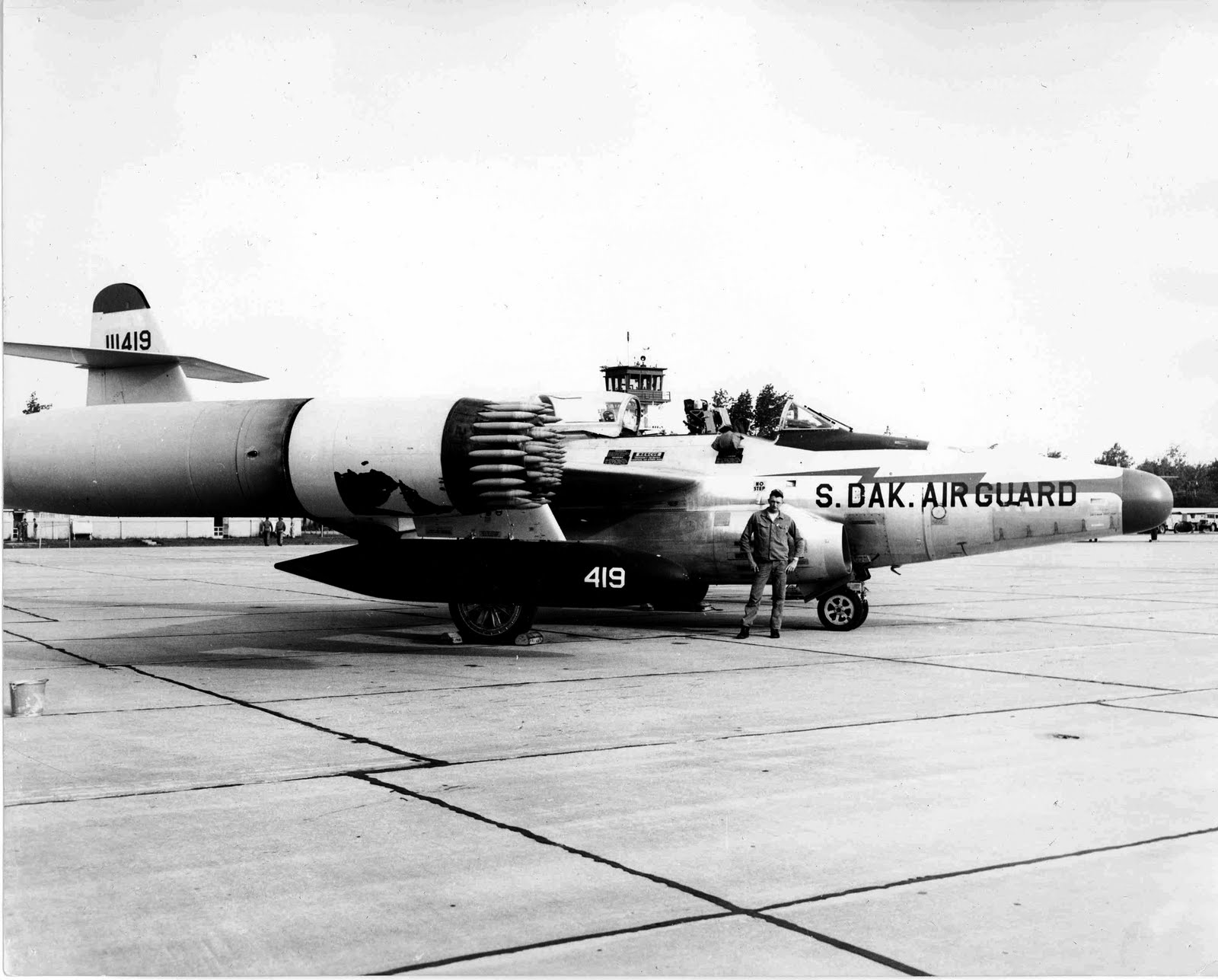
Image result for northrop f-89 scorpion joe foss
F-89D of the South Dakota Air Guard. The aerodynamic fairing over the front section of the rocket pod has been removed to show off all fifty-two rockets.
If ever a fighter embodied the Macross Missile Massacre trope, it was this one. With fire control settings allowing for one, two, or three total volleys, it was entirely possible to ripple off an entire rocket load in a single pass.

Later variants didn't really dial back the crazy much, either. The F-89H lost thirty-one rockets from each pod, but gained three guided missiles (GAR-1 and GAR-2, later AIM-4 Falcons) in their place. The missiles were stored inside the pod until ready for launching, at which point they hinged out into the airstream to be fired. Normally three heat seekers and three radar guided missiles were carried, with the thought that if one missed, the other would probably hit.


And then there was the F-89J. A major update of F-89D airframes, the -J lost the rockets entirely, although it kept the podded missiles, but in their place, it gained the ability to carry the Genie nuclear air-to-air missile. Because if you couldn't knock down bombers with a volley of rockets that would make a '90s anime fan say "that looks a little excessive" then shooting a nuclear missile at them makes perfect sense! As mentioned previously, the F-89J became the only American aircraft to fire a Genie during the Operation Plumbbob tests.

Really, what I love about the F-89 is what I love about a lot of aircraft from the '50s and '60s era of aviation: the sheer lunacy, coupled with engineering brilliance, that was so often on display in solving problems. Well, that and because the actual aviation embodiment of this gif makes me smile every time I think about it.

Monday, July 11, 2016

One Month In - New Rider Update

I'm officially a month in on this whole motorcycle rider thing. I've managed to accomplish two goals in that time, namely "Don't be the guy who crashes his new motorcycle on the way home from the dealer" and "Don't be the guy who crashes his new motorcycle before making the first payment."

Hooray for that. I've also discovered that my bike gets somewhere between 33-40mpg around town, which is a big enough improvement over my CUV that feeding the bike the premium gas it requires is still an overall cost savings.

I also got the "fun" experience of riding down the freeway with a heavy crosswind. That was interesting, with the wind blowing hard enough that I had to keep a slight lean just to stay in position. I think that if I do an Iron Butt run at some point, I'm going to want a mainly North-South route to keep the wind at my back or front, or start early enough running East-West that the wind is calm until I get out of the prairie. But that's still a ways off.

Unfortunately, I've also hit my first semi-serious squawk since the bad starter relay that shut me down on my first full day of riding. See, the previous owner had installed an aftermarket digital tachometer and shift light. It's a very drag racer kind of option, and not one that I would have picked up myself. Unfortunately, it also seems that the manufacturer decided to save a few pennies on cost and NOT WATERPROOF THE UNIT! So when my bike was parked in the office parking lot last week, and a lovely line of Midwestern thunderstorms marched through, well, my poor gauge has not been the same since. The electronics are still displaying, but it's not getting reliable information from the engine any more.

I'm hoping that I can fix the problem myself, that it's just a shorted connection. If not, well, that's probably coming off the bike. I don't need an tachometer, although it is nice to have. Shifting by speed and engine sound is pretty reliable. That said, Harley does make a drop in replacement combination Speedometer/Tachometer/Gear Indicator/Fuel Gauge that would solve a bunch of my complaints in one fell swoop. That's something I may end up picking up this winter during the riding off season.

Other than that problem though, riding has been great. A little warm in my full gear, but nothing that a change of close at the end of a ride can't solve.

Thursday, June 30, 2016

Motoring my Way To Better Health!

Throwback Throttle Thursday will (hopefully) be back tomorrow. I really want to do that Northrup F-89 story, but am out of time for the week. So, instead, let’s talk more about motorcycles! Specifically, the unexpected health benefit I’ve found in the couple weeks I’ve been riding and commuting on two wheels.


Here’s the thing. I have a bad fast food habit. Specifically, I have a bad fast food breakfast habit, which has cultivated over fifteen years of commuting. I’ve spent way too much money, and eaten way too many calories, because a McDonalds/Burger King/Taco Bell breakfast is convenient, cheap, and easy to eat while driving. Even with my current and much shorter commute, five minutes to roll through the drive-thru and bolt down a breakfast burrito before I hit the office parking lot is usually less time than actually sitting down to a bowl of cereal and an English muffin, much less actually frying up a couple of eggs or something.


And then there’s lunch. Now I really, really should pack a lunch every day. It’s cheaper, healthier, and since there’s no restaurants or food trucks within easy walking distance, slightly more convenient. Still, there’s plenty of options within a five minute drive, and sometimes I just don’t feel like making a sandwich ahead of time, or containerizing a batch of leftovers.


But now I have the bike, and that equation has changed. Have you ever seen a motorcycle at a drive-thru window? I mean, clearly people have done it, and have the youtube videos to prove it, but it’s not exactly an everyday occurrence. For me, as well, there’s the issue of where to put the paper sack of calories. I have saddlebags on my motorcycle, so that’s easy enough, but accessing them does require dismounting from the bike. And if I have to get off the bike anyway, then I might as well just go inside to place my order, and not paddle through the drive-thru lane.


But now we’re into convenience issues. That five minute drive-thru stop now takes longer, because I have to park, get off the bike, go inside, order, come back outside, put the food in a saddlebag, start up again, and roll out. So although I’ve done it a couple of times in the past couple of weeks, my fast food breakfast consumption is way down.


Lunch is a whole different problem. Breakfast, at least, I’m already dressed, since it’s on the way to work, but lunch? I ride ATGATT (All The Gear, All The Time) so “let’s go out for lunch” means “Hang on, let me change into my riding pants, then don jacket, gloves, helmet, and boots” before heading out to my bike. Actually, if I’m going with a group, I’ll probably just catch a ride from someone, but if I’m going alone, all that gear is a necessity, and turns a quick 15 minute run through the nearest drive-thru into a 30 minute mission that’s consumed half my lunch break! I’ve done that precisely once, and that was probably enough.

The health benefit is pretty simple, really. I’m eating better, and cheaper, basically because I’m lazy. Score one for basic human nature! Let's be honest here, should I be hitting the gym, running, or getting some other kind of physical exercise regularly? Absolutely. But there's also a saying that goes "You gain fitness in the gym, and lose weight in the kitchen." Improving my diet is a good place to start.

Monday, June 27, 2016

Motorcycling and Risk Management

Since taking my MSF class and getting my motorcycle license a couple of weeks ago, I've had this idea kicking around in my head, about the similarities and differences in risk management in my professional career, motorcycling, and flying.

Then a very smart project manager (whom I've never met) wrote that article for the Airline Reporter website. Although she's a helicopter pilot (I was working on my fixed wing license) and doesn't ride around on two wheels, she covered a lot of the same ground. In particular this section here:
No matter how much you train (or how excellent your school is), how well you pre-flight, the amount of sleep and nutrition you get, or the thoroughness of your planning and backup plans, there is risk involved when taking off and throughout the flight until the wheels are on the ground, key is out, and the blades stop turning. Risk will always exist, and as pilots we work to manage and mitigate this risk as much as possible. The only way to have zero risk is to never try and, well, that’s just failure.
However, no matter how much we mitigate, by nature of the job as a pilot, as you gain more experience, you take on more risk. When you start bringing passengers, you’re adding distractions. When you have advanced training, such as long-line or firefighting, it’s normal to advance in your career and do more risky things. Taking on more risk (in a responsible manner) equates to you achieving more – ultimately, literally saving lives.
You can apply exactly that to saddling up a motorcycle and riding. We can work to mitigate the danger by having more situational awareness, wearing protective gear, avoiding high risk situations such as drinking and driving, but there's still always risk.

Different people have different levels of risk tolerance in their own lives. I wouldn't try to fly a wingsuit through a two meter hole in a cliff, for example, but some people do. I won't ride without a full set of gear, which puts me in a distinct minority riding around in my home state. I'm not in favor of mandatory laws, just that you make an informed decision about whatever level of risk you choose to tolerate in your life.

Applying the same principle to work, some people stay with a job they hate, because the pay's good, the benefits are good, and the chance of leaving and failing is too great. Other people bet everything on succeeding in a start up. Nobody's wrong, and if they're making informed choices, good for them.

Ride safe, fly safe, and make smart decisions.