Caster's Corner - Livestreaming on Twitch

Showing posts with label World War II. Show all posts

Thursday, May 17, 2018

Book Review: Daughters of the Night Sky

Daughters of the Night Sky by Aimie K. Runyan paints a tale of love, comradery, and inevitable loss, set against the backdrop of World War II on the Eastern Front. Based on the actual exploits of the Night Witches – Russia’s all female volunteer pilot squadrons – the book tells a story that few Westerners know much about.


One thing that Daughters of the Night Sky isn’t, is an aerial action thriller. To me, the air portions felt like the weakest parts of the book, serving mainly to move the plot of the characters along. Basic terminology mistakes, such as saying that German planes would “stall their engines” in trying to engage the Night Witches’ slow Polikarpov U-2 biplanes, take focus away from the story being told.
Combat isn’t the focus of the book, however, so I’ll leave my criticism of the author’s aviation errors at that. Instead, the focus is on the life of Katya Ivanova as she goes through the war, moving from initial navigator training through to the end of the war with the women of her squadron. Along the way we’re introduced to her comrades and squadron mates, and the man she falls in love with and marries.

In reality, the women of the 588th flew near constant night bombing missions. Often flying eight or nine sorties a night, their primary role was to harass the nearby German camps and degrade the effectiveness of the enemy soldiers. By the end of World War II, their squadron had flown over 23,000 missions. For this, a squadron comprising a total of 261 women suffered 32 fatalities and 28 destroyed aircraft.

Katya and her squadron mates must deal with much more than German bullets, however. Sexist officers at every level cause nearly as many problems for the squadron as the enemy. The challenges push Katya and the others to work even harder, and show they are better than the male squadrons.
In the book, the author carefully tiptoes around the reality that the Easter Front was essentially two of the most grotesque mass-murdering tyrants the world has ever seen throwing bodies at each other. None of the main or supporting cast women that we meet are especially enthusiastic Communists, and several have a secret or two revealed along the way. It’s an understandable author’s decision not to include any particularly patriotic defenders of Stalin’s regime in the book, but it does detract a bit from the historical realism. It’s difficult to believe that none of the women who volunteered for flight duty were hardline Party supporters.

If you’re looking for descriptions of dramatic dogfights, tense cat and mouse battles with German fighters, and dramatic bombing runs, this book is going to be a disappointment. However, as historical fiction, it’s excellent and well worth anyone’s time.

Thursday, April 19, 2018

Flying Tigers Companion - Bristol Blenheim

When we last left our Flying Tigers companion series, we were discussing the almost totally unknown Vickers Vildebeest. We now come to a better known aircraft, the Bristol Blenheim.

The Blenheim wore a couple of hats over its career. Primarily a light attack bomber, it also served as a heavy fighter, an interim night fighter, and provided the basis for the Beaufort torpedo bomber. In Flying Tigers: Shadows Over China, Blenheim Mk IVs of No. 60 Squadron RAF are represented in several missions, usually placing players in combination scenarios where they play pilot/bombardier, then man a turret to fend off attacks from Japanese fighters.

Blenheims of No. 60 Squadron skimming VERY low over the 
water to attack Japanese shipping. (Wikipedia Public Domain)

Aside from FTSOC, the Blenheim isn’t especially well represented in flight and flight-action games. The Mk IV F version appears in World of Warplanes as a decent Tier IV fighter, and it’s a flyable option in IL-2 Sturmovik: Cliffs of Dover Blitz Edition, but that’s mostly it. In game terms, the Blenheim is largely overlooked in favor of the Beaufighter and Mosquito.

Late model Blenheim Mk IV with dual gun turret from World of Warplanes.

 Surviving Blenheims can be found in a few places in Europe. The sole flying example is technically a Bolingbroke Mk IVT (the name for Canadian manufactured Blenheims built by Fairchild Aircraft and used as coastal reconnaissance/light bombers) rebuilt with a short nose to appear as a Blenheim Mk I, and operated in Britain by the Imperial War Museum Duxford. Static display examples exist in the Aviation Museum of Central Finland (A Finnish Mk IV) and at the Hellenic Air Force Museum (A Mk IVF downed by friendly fire in 1941 and recovered for restoration in 1996).

Friday, April 13, 2018

Flying Tigers: Shadows Over China Mission Nine - Return to Mingaladon

On January 12th, 1942, the Japanese forces launched their Burma campaign. Though significantly outnumbered, the AVG and RAF aircraft based at Mingaladon inflicted outsized losses on the IJAAF attackers. The British radar operating at Mingaladon helped with early warning of incoming attacks.


By mid-February though, only ten P-40s were still operational at Mingaladon. The RAF would begin retreating and pull their radar equipment out by the end of February, forcing the remaining Flying Tigers to withdraw to bases in northern Burma.

This mission has some of the craziest cockpit hopping of anything in the game. Start in a Blenheim coming in for a landing, swap to a Hurricane, jump back into a Blenheim's turret, then finally into a P-40E to finish out. At least there's no shortage of variety.

Friday, April 6, 2018

Flying Tigers: Shadows Over China Mission Eight - The Hump

A semi-historical mission, flying "The Hump", the aerial resupply line from India to China, was the most dangerous cargo route of World War II.


When Japanese military success in the SBI effectively closed the only land resupply route into China, American forces had to find another way to supply operations in China. The only option was a long, dangerous flight over the Himalayan mountain range. The game mission suffers from a bit of an anachronism, in that the C-46 Commando transports did not begin operating on the route until 1943, while the mission is clearly intended to have taken place in 1942 when the AVG was still operating.

Details, what are you going to do?

An additional note of interest is the quote at the end of the mission. While it may sound a bit corny to modern ears, this is very close to a direct quotation from Dayne Kline, an engineer on the C-87 transports which also flew The Hump. His direct quote is as follows:
"Let there be no question about it! Flying the Hump was risky business. The air route led first over the Himalayan foothills and finally to the mountains, between north Burma and west China, airspace where turbulence and abominable weather was the norm. Judge for yourself: one of the peaks they flew over translated into English as "Elephant Head Gouge Mountain," because "when elephants use a game trail on its side, at one place they have to turn such a sharp corner that their tusks scrape grooves into the rock."

Thursday, April 5, 2018

Flying Tigers Companion: Vickers Vildebeest

Some planes just can’t catch a break. Aviation history is littered with aircraft that beat or matched some other aircraft on paper, but in reality, due to market forces, poor circumstances, or just simply bad luck, one falls into obscurity while the other gets well known. So it is with the Vickers Vildebeest.
A Vildebeest in flying. (Wikipedia)

Friday, March 30, 2018

Flying Tigers: Shadows Over China, Mission Seven - Lucky Day Akyab

In December 1942, the first attempt by British forces to retake Burma from the Japanese began with the attempted invasion of Akyab. An island containing a well built, all weather airbase, it represented a strategic location from which IJAAF aircraft could cover most of Central Burma with fighters and transports, and reach Rangoon with their medium bombers.


This mission simulates one possible attack on the airfield by Mk. IV Blenheims of the RAF’s No. 60 Squadron. During a single engagement on May 22th, 1942, a single Blenheim crew was credited with shooting down Lt Col Tateo Kat¬ō’s Ki-43 and badly damaging two other aircraft over the Bay of Bengal. Lt. Kat¬ō’s demise would prove a severe blow to the IJAAF.

Friday, March 23, 2018

Flying Tigers: Shadows Over China Mission Six - Train To Nowhere

Not a lot of historical details for this mission, though it is at least somewhat representative of the kinds of patrols the AVG would fly, particularly once they got their bomb-carrying P-40Es.


The forced landing and squeezing two people into the cockpit of a Hurricane IIb is a bit of a stretch, but “Rule of Cool”, Artistic license, and all that.

Thursday, March 1, 2018

Flying Tigers Companion: Westland Lysander

Continuing the deep dive into aircraft featured in Flying Tigers: Shadows Over China, today we come to the second aircraft featured in the opening mission - The Westland Lysander. As shown in the first mission, FTSOC largely treats the Lysander as a light bomber, which is the primary role it was used for by the Indian Air Force in the China-Burma-India theater. With its landing gear-mounted stub wings loaded with small bombs, the Lysanders of the IAF were adequate light bombers, at least until better aircraft arrived.
Canadian Warplane Heritage Museum's Lysander Mk III in target towing colors. (Wikipedia)

However, artillery scouting and harassment bombings were not the Lysander's claim to fame. Instead it would be the flat midnight black Lysander Mk IIIs of RAF No. 138 and No. 161 squadrons that would become famous for their support of spying and resistance operations behind enemy lines. Equipped with a large belly tank for extra range and a fixed ladder for faster ingress/egress from the rear cockpit, these aircraft slipped into and out of occupied territory, their excellent short field performance and relatively high cruising speeds allowing them to extract and insert over two hundred agents from 1941 to 1944.
The Shuttleworth Collection's Lysander Mk III. Wikipedia

Lysanders also performed a great number of other, less glamorous duties. The RAF and RCAF used them as target tugs, liaison aircraft, and as trainers. The Canadians also used them to patrol Canada's Eastern coastline with anti-submarine and search and rescue duties. For a brief time they were even equipped by two fighter squadrons when no other aircraft were available.

Today the roar of the Lysander's Bristol Mercury engine can still be heard on good days at some airfields in Canada (Canadian Warplane Heritage Museum and Vintage Wings of Canada), and in England (Shuttleworth Collection). Non-flying exmaples are displayed in Canadian, English, American, Belgian, and Indian museums.
Visible below the Monnett Moni is the NASM's Lysander. And their P-40. I wish I'd gotten individual pictures of those aircraft. Time to play another trip! (My photo).

Virtual pilots, unfortunately, are pretty limited in our options to simulate this aircraft. Lacking the "sexy" roles of fighter or bomber, I cannot recall any other flight-action games besides FTSOC where the Lysander has been represented. For sim pilots, the best bet is add-on mods for FSX, IL-2, or Combat Flight Sim 3.
IL-2 ingame screenshot of modded in Westland Lysander via the Free IL-2 Modding forums and forum member Gumpy

There are also no flying replica kits offered. A single, non-flying Lysander Mk III movie prop is being offered for sale, however. I wonder what my HOA'S rules would be on that?
Sure, this'll look great on my front lawn...
(Photo via Historic and Classic Aircraft Sales


Friday, February 23, 2018

Let's Play Flying Tigers: Shadows Over China Mission Two

Twelve days after the Japanese attack on Pearl Harbor, the American Volunteer Group got their first taste of combat. Ten unescorted Kawasaki Ki-48 "Lily" bombers heading towards Kunming were engaged by the 1st and 2nd squadrons. The bombers jettisoned their loads and ran, losing four aircraft along the way. Ultimately nine out of the ten aircraft failed to return to base, according to transmissions intercepted by Chinese intelligence.


The AVG suffered one crash-landed P-40B for their troubles.

Thursday, February 22, 2018

Flying Tigers Companion: Curtiss P-40 Warhawk

In conjunction with my Flying Tigers: Shadows Over China video series, I thought it would be fun to dig a little deeper into the history of some of the aircraft involved in the game. There's a few pretty obscure aircraft in there, but I thought I'd start with the most iconic aircraft in the game, the Curtiss P-40 Warhawk!

Developed from Curtiss's earlier P-36 Hawk, the base of the P-40 design was the same airframe as the Hawk, but redesigned from the firewall forward for the super-charged Allison V-1710 V-12 engine. NACA wind-tunnel evaluation of the basic shape ultimately pushed the engine's glycol coolant radiator forward to the chin position, creating the easily recognizable shape of the final aircraft.

The P-40Bs that originally equipped the AVG in China were armed with a pair of .50 caliber machine guns in the nose, firing through the propeller, and four .30 caliber machine-guns in the wings. Not as maneuverable in a turn as the Japanese Nates and Oscars that they tangled with, the AVG's P-40s maintained an advantage in dive speed and overall durability.
Fagen Fighters actually owns two flying P-40s, this P-40K which served in Russia, and a P-40E which flew in North Africa and is of the same type that the AVG flew. (My photo)

The AVG's P-40Bs lacked provision for drop tanks or bombs. In the spring of 1942, they received a handful of P-40Es, an upgraded model which remedied the B's chief vices: bomb racks, drop tanks, and better radios. The E models also traded the wing-mounted .30 caliber guns for a quartet of .50 caliber machine-guns.

Elsewhere, various P-40 models saw extensive service with the RAF in the North African theater against German and Italian aircraft. The USAAF used them in the Mediterranean theater (including use by the Tuskegee Airmen during their first eight months of combat), in Alaska, and in the Pacific, where a pair of P-40Bs were among the few to get off the ground and engage the Japanese during the attack on Pearl Harbor.

P-40E in AVG colors from IL-2 Sturmovik

The Soviets also received a number of aircraft via Lend-Lease. Not as numerous or popular as the P-39 Airacobra, the P-40 still proved a capable aircraft in the hands of Soviet pilots.

Those wishing to see the real thing are fortunate, as there are still a number of them in existence, both as museum displays and flying. Australia, Canada, New Zealand, France, the United Kingdom and the United States all have museums with one or more flying types in their collections, some of which make appearances at fairly far-flung airshows.

RAF Kittyhawk IIa from IL-2 Sturmovik
For those lacking the funding to purchase and restore one of these classics, there are a few plans or kit replicas that have been made available over the years. Currently Loehle Aircraft Corporation makes a replica kit, and both Jurca Plans and WAR Aircraft Replicas has previously had plans available. Unfortunately none of these companies have functioning websites at the date of this blog post.

Sim pilots will have a much easier time getting behind the controls of a P-40, as it is well represented across both the hardcore and flight-action genres. In addition to its appearance in Flying Tigers: Shadows Over China, P-40s can also be found in World of Warplanes (for both American and Russian fighter trees), Secret Weapons Over Normandy, IL-2, IL-2 Sturmovik: Battle of Stalingrad, Flight Sim World, and Damage Inc. Pacific Squadron WWII, among others. For the simulation minded, Flight Sim World or the IL-2 series would likely be the best options.

Monday, December 12, 2016

Museum Notes: Fagen Fighters World War II Museum

Drive two and a half hours West of Minneapolis, and you’ll find the town of Granite Falls, population 2,819. It seems like a lot of other small farming communities in the Midwest, but Granite Falls hides a secret. Just a little past the city center is the airport, (KGDB), an untowered, 4,300 foot runway with a small FBO and a few hangers. Inside one of those hangers, is one of the last ten flying P-38s in the world. Another contains a beautifully restored and flying B-25N called Paper Doll. A third hanger holds restoration facilities where an SB2C-5 Helldiver is slowly being returned to flying shape, and one of only five flying JN-4 Jennys left.

The museum's Curtiss JN-4 Jenny, with their two gliders and the halftrack in the background.
Flight-worthy BT-13 and B-25N share hanger space with a
non-flying BF-109 and the museum's Holocaust exhibit.
It was a very cold day when my son and I made a visit to the Fagen Fighters World War II Museum. The prevailing wind blowing across the ramp pushed the perceived temperature into the negatives, and seemed to have kept most weekday visitors away. My son and I had the museum’s three separate hangers almost totally to ourselves. There’s something about a quiet hanger filled with working aircraft that gives a museum like Fagen, or Planes of Fame a different feeling than a regular aviation museum. Maybe it’s the smell of oil dripping from radial engines, maybe it’s the sense of potential: that these machines could awake from their slumber at any moment and hurtle skyward once again. It’s probably the oil.
CG4A cutaway

Aside from the P-38J, JN-4, and B-25N, Fagen is also home to a pair of flying P-51Ds; a P-40E and P-40K; an FM-2 Wildcat; PT-19, PT-22, PT-26, and BT-13 trainers, and an operational M4 Sherman tank. There’s a number of other military vehicles on display, and an amazing Waco CG4A Glider with one side cut-away to show how this aircraft was constructed.


If you’re close enough to make the drive, or are passing through the area on your way to somewhere, I highly recommend making plans to spend a few hours at this museum. Better still for pilots is the fly-in option. The FBO is small but comfortable, and the airport dog (because every good small airport FBO has a dog, right?) is a friendly fellow. Fly-in, grab a hundred-dollar hamburger in town, and spend the day walking among slumbering legends. Or, if you come on a better flying day than I did, maybe share the pattern with a few of them while they get some exercise.

Tuesday, September 6, 2016

AvGeek Gamer History: The Horten Ho-229

The Air and Space Smithsonian magazine recently published an article on one of my favorite lost World War II aircraft, the Horten Ho-229 flying wing. I was priveledged to see this aircraft in the preservation center last year, where the lone survivor looked like this.
Wings are on the right.
That still looks better than when I first learned about this aircraft, from a pixelated cockpit in a game called Secret Weapons of the Luftwaffe.

Secret Weapons of the Luftwaffe DOS Go229 - Flying through B17 formation
Screaming through a B-17 formation.
(screenshot courtesy of MobyGames.com)

If I were to point to a game that really fired my love of weird late WWII aircraft, it would have to be SWotL. The Ho-229 (GO-229 in-game), DO-335, He-162, and others all took flight on an old 386DX computer and fired my imagination.

Seeing a survivor of these types, even in a partially assembled condition, is a rush. Here's hoping that the NASM can get their bird into display condition at some point. I'd love to see it in the gallery with the DO-335 and ME-163.

A more modern, and difficult, take on the Ho-229 can be found in IL-2 Sturmovik: 1946.
Over the top in IL-2.

In both game versions, the Ho-229 is imagined as what an operational version would have been: a fast bomber interceptor armed with a pair of 30mm cannons, and underwing hardpoints for air-to-air rockets or bombs for ground attack.

Thursday, August 11, 2016

Kids and Airshows


Two weeks ago, we had the opportunity to attend the Offut airshow near Omaha, Nebraska. The week before, we'd attended the Sioux Falls Airshow, which I wrote a bit about.

Once again, the kids had a blast. I've not seen the Thunderbirds in over twenty years, so that was a treat for me as well. Randy Ball in the MIG-17PF (the only one of its type flying in the Western world) was another treat. That bird puts on a show, particularly with the afterburner lit!

d
Pictures don't do this thing justice. That afterburner stream pulses like no modern aircraft does.
(Pictures from the FIGHTERJETS INC website)
One of the oft-repeated things said about the benefits of airshows and flight demonstration teams like the Thunderbirds and Blue Angels is that they help inspire future generations to want to fly, seek out careers in aviation, and generally dream bigger.

This year I think I got to see, and hear, that for myself.
"Who wants to fly that jet behind you?"

Time will tell, but there could be a future Thunderbird pilot in that shot.

It was a great show. I wish I could have spent some more time in the static display areas, where the CAF squadrons were quite well represented, but hopefully I'll get time for that next year. Oh yeah, we'll be back for this one again!

A-26B Lady Liberty

Thursday, July 28, 2016

Ghosts of Airshows Past - White Lightning


Poking through various corners of the internet for information about the the P-38 which flew in the Heritage Flight at last weekend's Sioux Falls airshow brought me to a fascinating history of another P-38, one I was much more familiar with: White Lightning, a P-38L flown and raced by Lefty Gardner throughout the '70s, '80s, and '90s.

I remember White Lightning from the Reno Air Races. Much like Bob Hoover and Ole Yeller, at the time, Lefty and White Lightning would both race in the Unlimited Class, and put on an airshow. I recall his P-38 act as being graceful, and sounding like nothing else with those twin Allisons singing in harmony.

White Lightning as I remember her.
I didn't realize that in 2001, she was seriously damaged in a crash after an engine failure and fire, although the pilot, Ladd Gardner (Lefty's son) was unharmed.
Even more to to the point, I had absolutely no idea that the beautiful, gleaming silver Red Bull P-38 that visits air shows around Europe, was White Lightning reborn!
Red Bull P-38
You'd never guess they were the same aircraft.

Although it's a shame that I'll never see that twin boomed white and red beauty race around the pylons at Reno again, it's good to know that she's still flying, and in great hands with the Red Bull team.


This post would not have been possible without information gathered from the P-38 Lightning Association


Thursday, June 2, 2016

The Night Witches of World War II

The German sentry stands at his post, trying desperately not to doze off. He’s cold, hungry and tired, the combination of Russian winter, lack of food, and lack of sleep making him wobble on his feet.

A whisper of wind brushing through wires is the only warning he gets, before a series of six explosions light up the night around him and a blast wave slams him to the ground. Ears ringing, he gets up to try and sound an alarm, train a searchlight, shoot something!

In the distance, a 110hp radial engine coughs to life, and the fragile Po 2 biplane, freed of its bombload, slips away from the chaos and into the cold Russian night, heading back towards its home base for another bomb load and another target. There will be no sleep in the German camps tonight, for the Night Witches are on the prowl once again.


In writing about night fighters, I’ve largely focused on their origins, and use in the European and Pacific theaters by British, American, and German forces. Most of these aircraft share some common traits: heavy cannon armaments, radar, multiple crewmembers, and twin engines (exceptions being the U.S. Navy’s F6F-3N and -5Ns). They swept the skies for enemy bombers, engaged other night fighters, and employed their heavy armament as the first in a long line of “All-Weather” attack aircraft.

But on the Russian front, while not technically a fighter group, there’s one specific unit I want to highlight: the 588th Night Bomber Regiment, the only all female air combat unit to operate in frontline service during World War II.

They didn’t fly advanced, all weather, radar equipped aircraft. In fact, the Polikarpov Po-2s were obsolete by 1930s standards, much less by the 1940s. Flying in crews of two, pilot and navigator, they operated their old, slow, open cockpit biplanes exclusively at night, sometimes flying eight or more sorties a night, flying low, cutting the engine near the target to glide in, release their bombs, then restart the engine and escape.

The Germans gave them the name “Nachthexen” or “Night Witches” for the sound the wind made whistling through the bracing wires of the Po-2s while the pilots glided in for an attack. They said it sounded like broomsticks, and thus the nickname was born.

Polikarpov Po-2

Their primary defensive tactic against the much faster, well armed BF-109s and FW-190s was a series of tight circles. The Po-2’s top speed was below the stall speed of the German fighters, and German pilots found it difficult to keep the slow, wildly maneuvering aircraft in their sights long enough to bring them down.

This isn’t to say they didn’t try. The Night Witches’ aircraft often returned with bullet holes punched through the fabric of the fuselage and wings, and thirty members of the squadron died during combat.


It’s a fascinating and largely untold (in the West) story. This unit put together a record that would be a credit to any air combat unit, and did so under some of the worst possible conditions, using antiquated aircraft, against some of the best pilots the German Luftwaffe fielded.

Thursday, May 19, 2016

Night Fighters - WWII Pacific Theater


The Japanese military never really caught up to the other major players in terms of Radar development during World War II. This meant that American (and British) night fighters operating in the Pacific theater had a lot less work intercepting enemy fighters, and a lot more time dealing with night bombing raids, and conducting air to ground and anti-shipping attacks, tasks which their heavy cannon armaments made them well suited for.


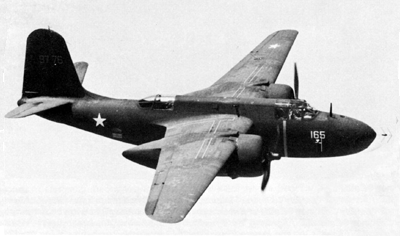
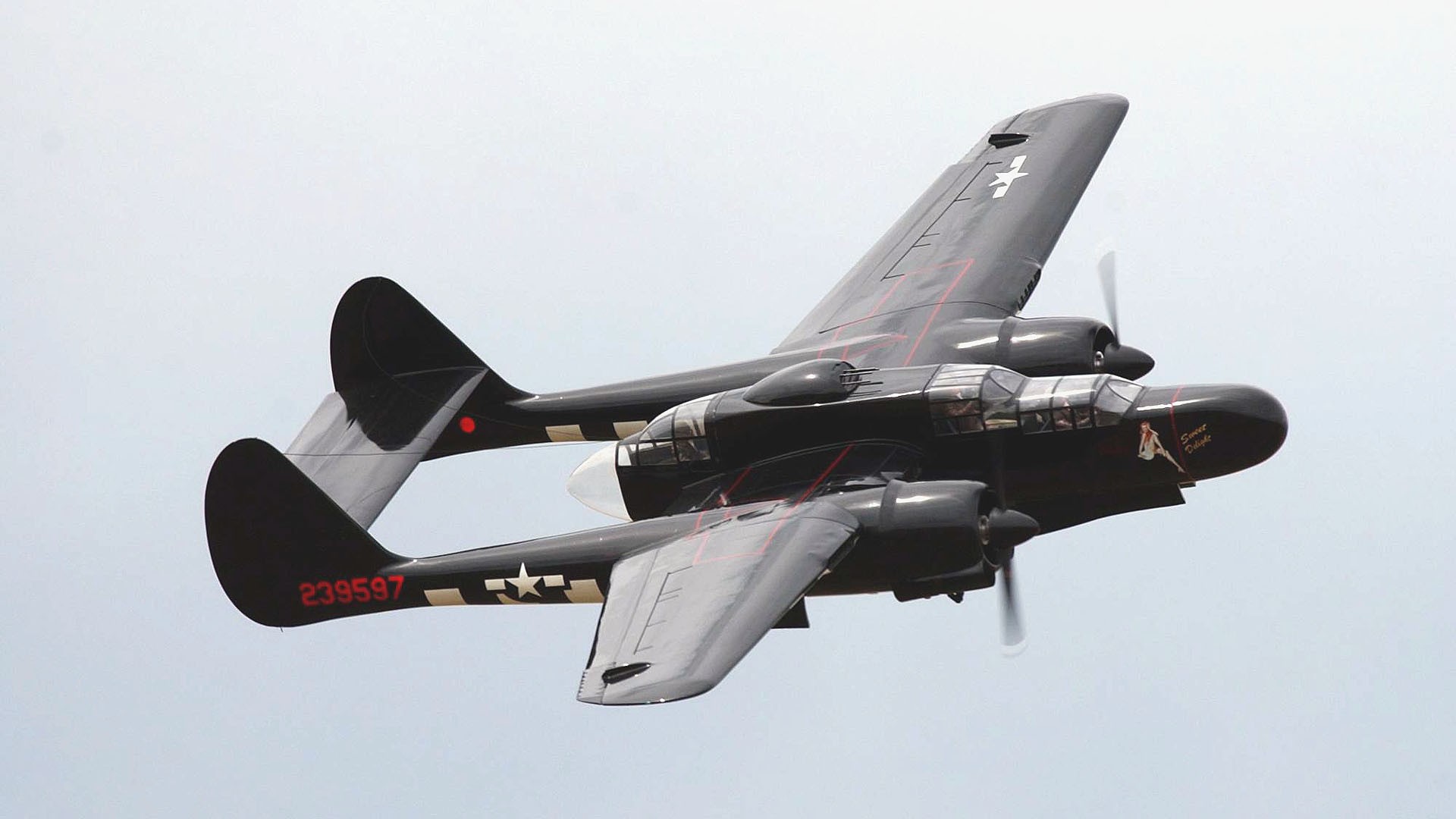
In the American Army Air Force, the primary night fighters were the P-70 Nighthawk, a development of the A-20 Havoc attack bomber, and the P-61 Black Widow. It was a P-61 Lady in the Dark that is unofficially credited with making the last kill of the war, forcing a Japanese fighter into the ocean.

http://www.ibiblio.org/hyperwar/USN/ref/NightFighterRadars/images/P-70.gif
P-70 Nighthawk in flight. Introduced in 1942, it was totally supplanted
by the P-61 Black Widow by 1944.


https://images.alphacoders.com/461/461034.jpg
P-61C (flying model) in flight. Because I can never have enough
Black Widow pictures

For the Navy, another solution was required. The medium bomber sized night fighters of the AAF simply wouldn’t work on a carrier. Fortunately, the AN/APS-4 (and later AN/APS-6) radars were sufficiently developed that the F6F-3 and F6F-5 Hellcats could carry them in a set of fairings in the belly and right wing. It wouldn't win any beauty contests (not that the Hellcat ever would anyway) but it was effective. So effective in fact, that the replacement for the F6F-5N would be the radar equipped F4U-5N Corsair, which would serve through the Korean conflict.
http://www.ffaa.net/aircraft/hellcat/images/hellcat-001.jpg
F6F-5 Hellcat. Note the telltale fairing on the right wing containing sensors.
 

Thursday, May 12, 2016

Night Fighter History - World War II European Theater, German Aircraft

German night fighter development in WWII largely followed a similar path to that of British fighter development. For the bulk of the war, the primary night fighters were the Ju-88 C/R/G, a conversion of the Ju-88 fast medium bomber, and the Bf-110, a twin-engine heavy fighter which, though too slow for day use, was able to loft the heavy early radar sets and attack the British bomber raids.

One of the chief innovations of the the German night fighters was the Schräge Musik (translated to "Jazz Music") weapon mounting, where one or two 20mm or 30mm cannon were mounted at around a 70° upwards angle in the mid-fuselage. This allowed the aircraft to fly underneath enemy bombers and attack with less risk.
Messerschmitt Bf. 110G night fighter
Radar equipped Junkers Ju-88
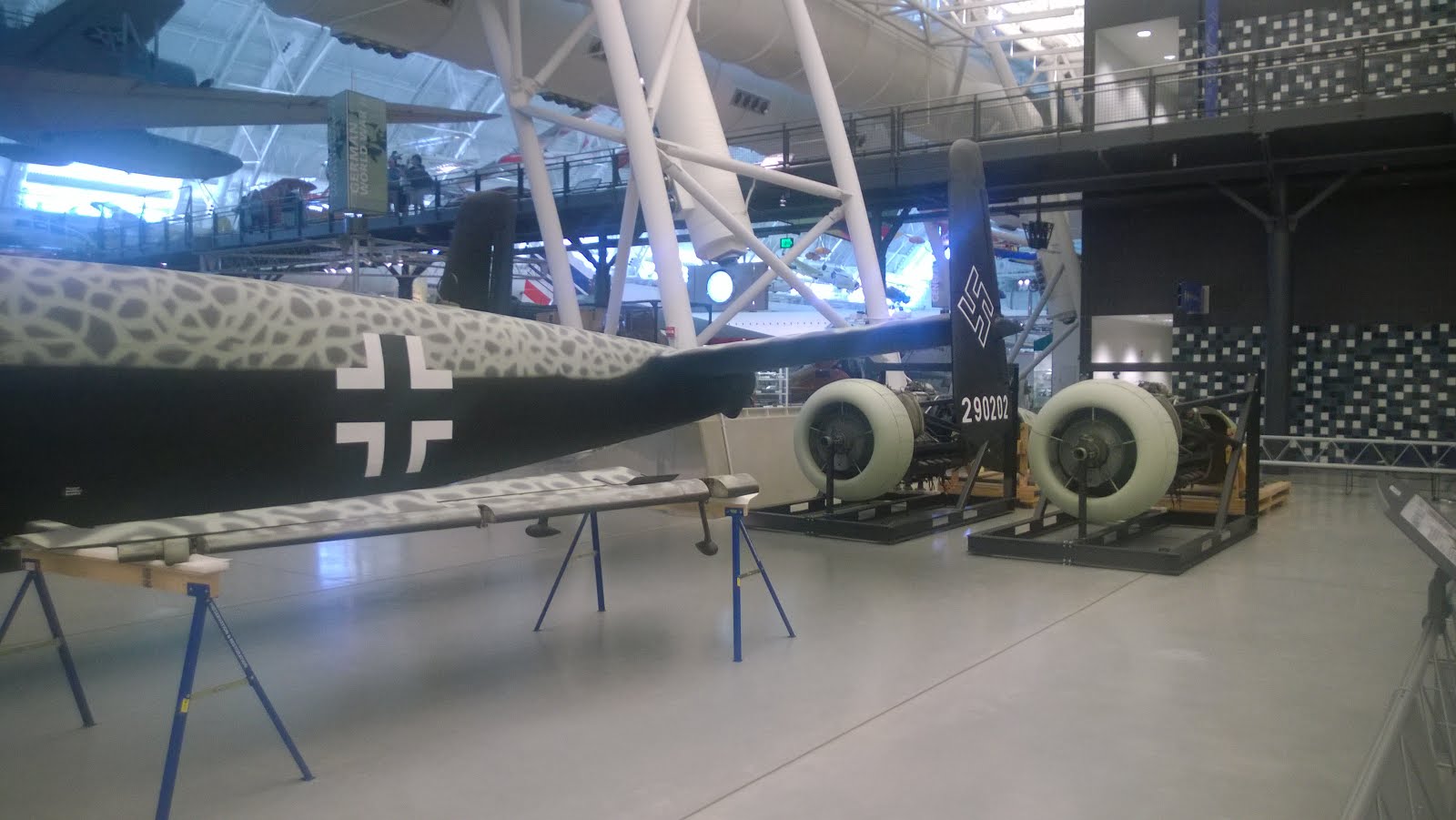
A number of other aircraft were deployed as night fighters, however most of them were either not sufficient improvements over the Ju-88s and Bf-110s, or not produced in sufficient numbers to make a difference. One of the most interesting one, however, was the Heinkel He 219. First operational in June 1943, it was the only German night fighter capable of matching the Mosquito.

Looking somewhat gangly on its tricycle gear, the Uhu (Owl) generally carried an armament of six 20mm cannons facing forwards, and a pair of 30mm cannons in the Schräge Musik position.

NASM's He 219 in July 2015.
Engines and wing panels. Hopefully it'll be fully assembled next time I visit.

Thursday, May 5, 2016

Night Fighter History - World War II European Theater - Allied Aircraft

As the Battle of Britain ended, and the German Luftwaffe moved to night raids on British cities, it became apparent that using ground radar guidance and mostly obsolescent day fighters, or unsuitable oddballs such as the Boulton-Paul Defiant, was inssuficient to deal with the German bomber streams. What was needed, was something that could carry a more powerful armament, while still being able to lift the heavy early radar systems.

Enter the Bristol Beaufighter. A successful development of the Beaufort torpedo bomber, Beaufighter Mk. I and Mk. II models carried a quartet of 20mm cannons in the lower fuselage, and had sufficient space in the nose to mount a radar. Beaufighters served in this role until mid 1942, when they were replaced by the ultimate British nightfighter (among its many extremely successful roles) the de Havilland Mosquito.
A Merlin equipped Beaufighter Mk. II
Beginning with the Mosquito NF MK II, and progressing through the NF Mk 30, the Mosquito was the primary night fighter of the RAF. It carried four 20mm cannons in the belly, and four .303 (7.7mm) machine guns mounted either in the nose, or under the forward fuselage depending on the model. They carried a variety of radars as the technology improved, and were said to have been so successful against both German bombers and night fighters that kill awards for shooting down a Mosquito were double that of other night fighters.

A well preserved Mosquito NF Mk II

The only American built night-fighter to serve in the European theater was the Northrup P-61 Black Widow. Armed with four 20mm cannons in the belly, and four .50cal (12.7mm) machine guns in a dorsal turret that was left off some of the -B models due to buffeting, the P-61 served in both the European and Pacific theaters.

In Europe, the P-61s served as both as a night hunter, and with its heavy cannon armament, also served as a night intruder attack aircraft in the last phases of the war.
A pair of P-61As (notable for the lack of dorsal turret).
Next week I'll get into the German night fighters, which showcase some fairly interesting problem solving.

Thursday, April 28, 2016

It Seemed Like a Good Idea at the Time - Turret Fighters


I'll (hopefully) pick up my Night Fighters series proper next week. This week, however, I'm going to focus on one of the weird sideshows from the beginning of WWII aviation, and an aircraft that was pressed into service as a night fighter for a while.

It must have seemed like a good idea at the time. In the late 1930s, light- and medium-bombers were outpacing the late model biplane fighters of the day, and it was generally believed that speed, combined with massed turret fire, would allow bombers to attack enemy targets without need for fighter cover. Of course, this thought didn't stop British Fighter Command from asking something along the lines of "Well and good for the enemy, but we can't have our fighters getting shot to pieces. How are we going to intercept the enemy bombers?"

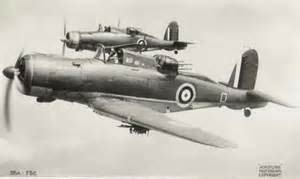
One of the answers went something along the lines of "Well, if turrets are good for bombers, then they'll be great on fighters! Do that!" And so, approximately, were born the Boulton Paul Defiant for the RAF, and Blackburn Roc for the Royal Navy.

Unlike the Defiant, the Roc also carried provision for
underwing weapons, and intended for ground-attack
duties as well.
Blackburn Roc. Ugly in a uniquely British way.
Still not a good fighter, but Merlin engines make everything
at least somewhat better.

Boulton-Paul Defiant


On the surface, it was a concept that solved a couple  of problems. The gunner freed up the pilot to focus on interception and flying duties, while the turret allowed for attacking enemy bombers from underneath, where fewer guns could be brought to bear.

Unfortunately, in actual combat, the turret fighter concept proved cripplingly vulnerable to single-seat enemy fighters. The extra weight of the turret and lack of forward armament put the turret fighters at a serious disadvantage against lighter, faster, more maneuverable opponents. Defiants did have some early success, primarily against German pilots who mistook them for Hawker Hurricanes and initiated attacks from the rear. Lessons subsequently learned, squadrons equipped with Defiants soon began suffering significant loses.

As a stop-gap measure until the Bristol Beaufighter became sufficiently operational, Defiants were re-assigned to night fighter duties. They saw some successes in this role, equipped with some of the early airborne radars, but were soon replaced by the Beaufighter, and eventually the Mosquito. Surviving Defiants were re-assigned to serve as trainers and target tugs,

Like any number of military innovations throughout history, the turret fighter was born from ideas that seemed good on paper, but failed in reality. The sole surviving Defiant is on display at the Royal Air Force Museum in London. No Rocs appear to have survived.

Thursday, April 14, 2016

Meeting the Black Widow

It all started with my grandfather. He had taken over pastoral duties at the church which was part of a local retirement community. One Sunday evening, he introduced me to a member of his congregation – a WWII veteran who had flown night fighters for the Army Air Force.

It would be a gross understatement to say that I was awestruck. Even as a kind of obnoxious young teenager, meeting an actual WWII fighter pilot was a huge honor for me. I wish I could remember what I asked him, but I guess I made a reasonably good impression, because for the next couple of years my grandfather played middleman, conveying a few neat aviation pictures and books from Mr. Stewart to me.

The pictures depicted aircraft from WWII, but not the familiar Mustangs, Spitfires, Corsairs, Hellcats, and Lightnings. Not even the dreaded enemy BF-109s, FW-190s, or Zeros were seen. Instead these aircraft were the bulky Tigershark, sleek Mosquito, oddly proportioned Beaufighter, and the sinister Black Widow.
My personal copy of Symphony In Black, SN #79/100. Signed by the artist, Dan Kelly, and Bill Stewart, Al Lockard, Ray Mann, Alvin E. "Bud" Anderson, and Lee Kendall

Three of the four aircraft in Gary Olson's Night Fighters series. From Left to Right is the DeHavilland Mosquito, Bristol Beaufighter, and Northrup P-61B. Not shown is the Douglas P-70.

I was hooked. I knew very little about night fighters, a side of the WWII air war that is rarely written about, but was no less important. More than that, staring at these pictures made me want to see one of these aircraft in person – the P-61 Black Widow, the same aircraft that Bill Stewart flew.

Now in the 1990s, if you wanted to see an intact P-61, there were exactly two places in the world you could go: the National Museum of the United States Air Force at Wright-Patterson Air Force Base in Dayton, Ohio, USA; or the Beijing Air and Space Museum in Beijing, China. For me, both those destinations were equally unobtainable. Oh, the National Air and Space Museum had a Black Widow as well, but it was tucked away in one of their storage facilities, another artifact they had no room to display.

Those pictures travelled with me. I grew up, got married, and Symphony in Black went up in our first apartment. We bought our first condo, and Symphony in Black went up office (and eventual nursery) while the India Ink drawings split their locations between the living room and office.

Time passed, and with the opening of the Udvar-Hazy Center at Dulles, the ranks of intact, viewable P-61s grew to three. Still, as a resident of the West Coast, Washington D.C. wasn’t any more convenient than Dayton or Beijing. And that’s how it remained, until an interview brought me out to Washington D.C. in July of last year, with enough time in my schedule after arrival to spend a few hours at the Udvar-Hazy Center.

Seeing the aircraft I’d dreamed about for so many years in person was, to be honest, a bit overwhelming. Sitting in the museum, surrounded by other aircraft of the era, gave a real scale of just how big the P-61 was compared to its contemporaries.

NASM's P-61C-1NO on display. In the post-war era, this aircraft had its weapons removed and was used for swept wing research by NACA. When it was restored and put on display, the decision was made to show it in research, rather than wartime, configuration. Thus the weapons were not replaced for display.

Longer shot to show the scale of the P-61. It dwarfs the single-engine fighters of the same era displayed near it, and really is only outshone by the B-29 Enola Gaybehind it.
I saw a lot of amazing, one of a kind aircraft that day. But when closing time came, the P-61 was the one I came back to for one last look.


I’d also like to note that the Mid-Atlantic Air Museum has a fourth P-61, which they’ve been slowly restoring to flight status since 1991. Assuming they eventually get it completed, I fully intend to be there, to see and hear one of these amazing aircraft fly again!