It all started with my grandfather. He had taken over
pastoral duties at the church which was part of a local retirement community.
One Sunday evening, he introduced me to a member of his congregation – a WWII
veteran who had flown night fighters for the Army Air Force.
It would be a gross understatement to say that I was
awestruck. Even as a kind of obnoxious young teenager, meeting an actual WWII
fighter pilot was a huge honor for me. I wish I could remember what I asked
him, but I guess I made a reasonably good impression, because for the next
couple of years my grandfather played middleman, conveying a few neat aviation
pictures and books from Mr. Stewart to me.
The pictures depicted aircraft from WWII, but not the
familiar Mustangs, Spitfires, Corsairs, Hellcats, and Lightnings. Not even the
dreaded enemy BF-109s, FW-190s, or Zeros were seen. Instead these aircraft were
the bulky Tigershark, sleek Mosquito, oddly proportioned Beaufighter, and the
sinister Black Widow.
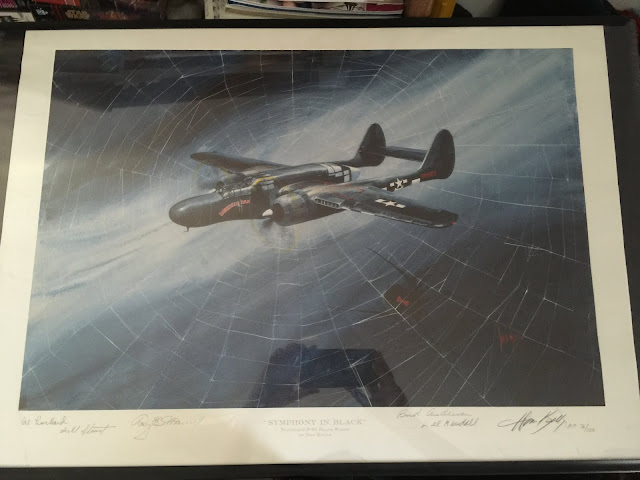 |
| My personal copy of Symphony In Black, SN #79/100. Signed by the artist, Dan Kelly, and Bill Stewart, Al Lockard, Ray Mann, Alvin E. "Bud" Anderson, and Lee Kendall |
 |
| Three of the four aircraft in Gary Olson's Night Fighters series. From Left to Right is the DeHavilland Mosquito, Bristol Beaufighter, and Northrup P-61B. Not shown is the Douglas P-70. |
I was hooked. I knew very little about night fighters, a
side of the WWII air war that is rarely written about, but was no less
important. More than that, staring at these pictures made me want to see one of
these aircraft in person – the P-61 Black Widow, the same aircraft that Bill
Stewart flew.
Now in the 1990s, if you wanted to see an intact P-61, there
were exactly two places in the world you could go: the National Museum of the
United States Air Force at Wright-Patterson Air Force Base in Dayton, Ohio,
USA; or the Beijing Air
and Space Museum in Beijing, China. For me, both those destinations were
equally unobtainable. Oh, the National Air and Space Museum had a Black Widow
as well, but it was tucked away in one of their storage facilities, another
artifact they had no room to display.
Those
pictures travelled with me. I grew up, got married, and Symphony in Black went
up in our first apartment. We bought our first condo, and Symphony in Black went
up office (and eventual nursery) while the India Ink drawings split their locations
between the living room and office.
Time passed, and with the opening of the
Udvar-Hazy Center at Dulles, the ranks of intact, viewable P-61s grew to three. Still, as a
resident of the West Coast, Washington D.C. wasn’t any more convenient than
Dayton or Beijing. And that’s how it remained, until an interview brought me
out to Washington D.C. in July of last year, with enough time in my schedule
after arrival to spend a few hours at the Udvar-Hazy Center.
Seeing the aircraft I’d dreamed about for so many years in
person was, to be honest, a bit overwhelming. Sitting in the museum, surrounded
by other aircraft of the era, gave a real scale of just how big the P-61 was
compared to its contemporaries.
 |
| NASM's P-61C-1NO on display. In the post-war era, this aircraft had its weapons removed and was used for swept wing research by NACA. When it was restored and put on display, the decision was made to show it in research, rather than wartime, configuration. Thus the weapons were not replaced for display. |
 |
Longer shot to show the scale of the P-61. It dwarfs the single-engine fighters of the same era displayed near it, and really is only outshone by the B-29 Enola Gaybehind it.
|
I saw a lot of amazing, one of a kind aircraft that day. But
when closing time came, the P-61 was the one I came back to for one last look.
I’d also like to note that the
Mid-Atlantic Air Museum has a
fourth P-61, which they’ve been slowly restoring to flight status since 1991. Assuming
they eventually get it completed, I fully intend to be there, to see and hear
one of these amazing aircraft fly again!


