Caster's Corner - Livestreaming on Twitch

Showing posts with label WWII. Show all posts

Thursday, May 19, 2016

Night Fighters - WWII Pacific Theater


The Japanese military never really caught up to the other major players in terms of Radar development during World War II. This meant that American (and British) night fighters operating in the Pacific theater had a lot less work intercepting enemy fighters, and a lot more time dealing with night bombing raids, and conducting air to ground and anti-shipping attacks, tasks which their heavy cannon armaments made them well suited for.


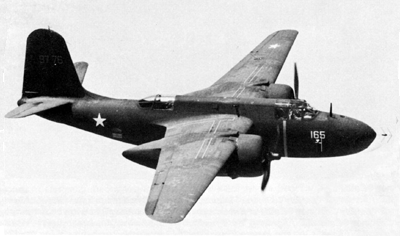
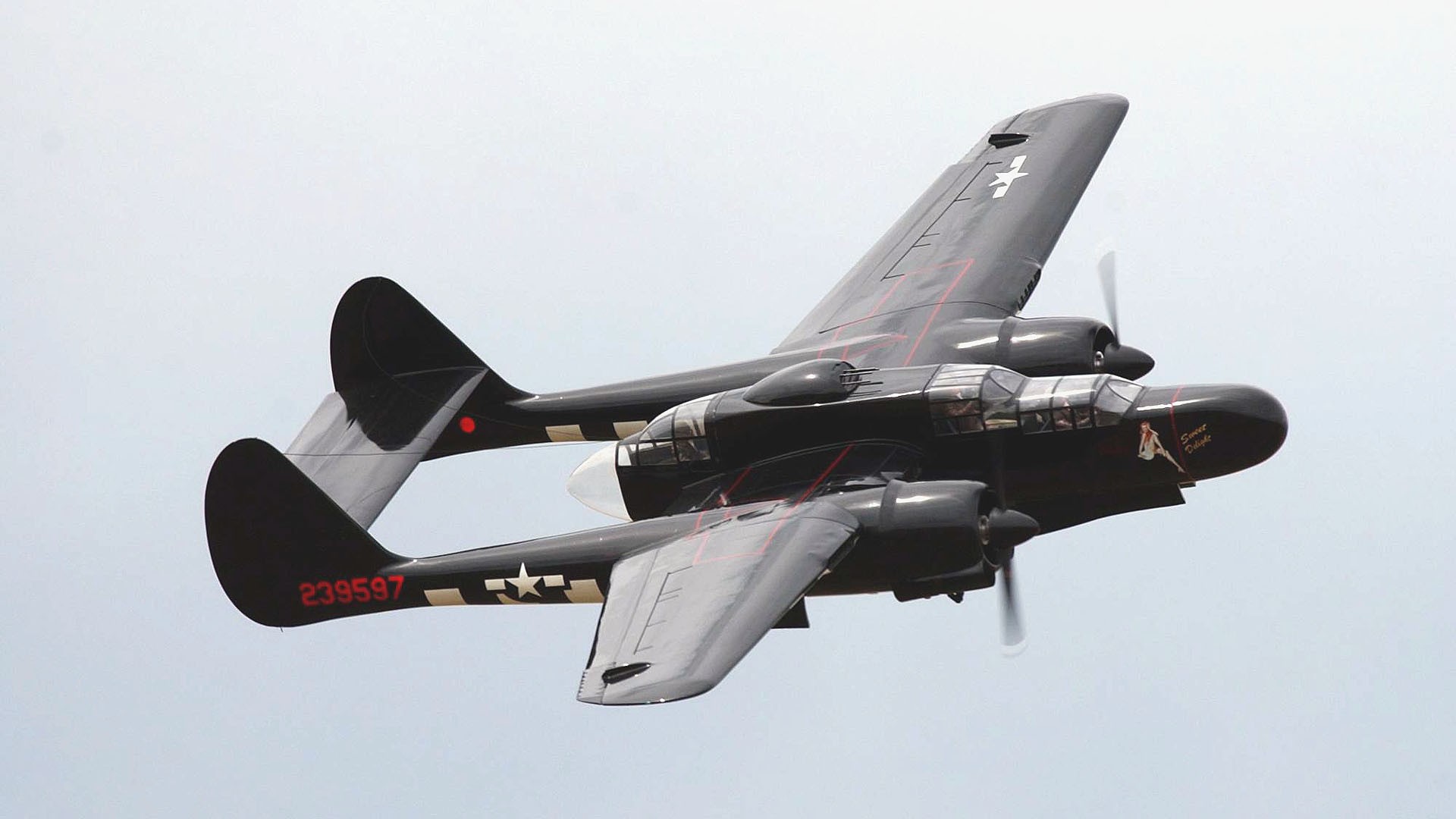
In the American Army Air Force, the primary night fighters were the P-70 Nighthawk, a development of the A-20 Havoc attack bomber, and the P-61 Black Widow. It was a P-61 Lady in the Dark that is unofficially credited with making the last kill of the war, forcing a Japanese fighter into the ocean.

http://www.ibiblio.org/hyperwar/USN/ref/NightFighterRadars/images/P-70.gif
P-70 Nighthawk in flight. Introduced in 1942, it was totally supplanted
by the P-61 Black Widow by 1944.


https://images.alphacoders.com/461/461034.jpg
P-61C (flying model) in flight. Because I can never have enough
Black Widow pictures

For the Navy, another solution was required. The medium bomber sized night fighters of the AAF simply wouldn’t work on a carrier. Fortunately, the AN/APS-4 (and later AN/APS-6) radars were sufficiently developed that the F6F-3 and F6F-5 Hellcats could carry them in a set of fairings in the belly and right wing. It wouldn't win any beauty contests (not that the Hellcat ever would anyway) but it was effective. So effective in fact, that the replacement for the F6F-5N would be the radar equipped F4U-5N Corsair, which would serve through the Korean conflict.
http://www.ffaa.net/aircraft/hellcat/images/hellcat-001.jpg
F6F-5 Hellcat. Note the telltale fairing on the right wing containing sensors.
 

Thursday, April 28, 2016

It Seemed Like a Good Idea at the Time - Turret Fighters


I'll (hopefully) pick up my Night Fighters series proper next week. This week, however, I'm going to focus on one of the weird sideshows from the beginning of WWII aviation, and an aircraft that was pressed into service as a night fighter for a while.

It must have seemed like a good idea at the time. In the late 1930s, light- and medium-bombers were outpacing the late model biplane fighters of the day, and it was generally believed that speed, combined with massed turret fire, would allow bombers to attack enemy targets without need for fighter cover. Of course, this thought didn't stop British Fighter Command from asking something along the lines of "Well and good for the enemy, but we can't have our fighters getting shot to pieces. How are we going to intercept the enemy bombers?"

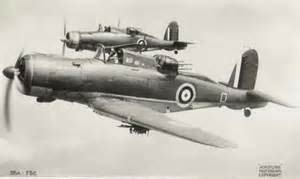
One of the answers went something along the lines of "Well, if turrets are good for bombers, then they'll be great on fighters! Do that!" And so, approximately, were born the Boulton Paul Defiant for the RAF, and Blackburn Roc for the Royal Navy.

Unlike the Defiant, the Roc also carried provision for
underwing weapons, and intended for ground-attack
duties as well.
Blackburn Roc. Ugly in a uniquely British way.
Still not a good fighter, but Merlin engines make everything
at least somewhat better.

Boulton-Paul Defiant


On the surface, it was a concept that solved a couple  of problems. The gunner freed up the pilot to focus on interception and flying duties, while the turret allowed for attacking enemy bombers from underneath, where fewer guns could be brought to bear.

Unfortunately, in actual combat, the turret fighter concept proved cripplingly vulnerable to single-seat enemy fighters. The extra weight of the turret and lack of forward armament put the turret fighters at a serious disadvantage against lighter, faster, more maneuverable opponents. Defiants did have some early success, primarily against German pilots who mistook them for Hawker Hurricanes and initiated attacks from the rear. Lessons subsequently learned, squadrons equipped with Defiants soon began suffering significant loses.

As a stop-gap measure until the Bristol Beaufighter became sufficiently operational, Defiants were re-assigned to night fighter duties. They saw some successes in this role, equipped with some of the early airborne radars, but were soon replaced by the Beaufighter, and eventually the Mosquito. Surviving Defiants were re-assigned to serve as trainers and target tugs,

Like any number of military innovations throughout history, the turret fighter was born from ideas that seemed good on paper, but failed in reality. The sole surviving Defiant is on display at the Royal Air Force Museum in London. No Rocs appear to have survived.

Thursday, April 14, 2016

Meeting the Black Widow

It all started with my grandfather. He had taken over pastoral duties at the church which was part of a local retirement community. One Sunday evening, he introduced me to a member of his congregation – a WWII veteran who had flown night fighters for the Army Air Force.

It would be a gross understatement to say that I was awestruck. Even as a kind of obnoxious young teenager, meeting an actual WWII fighter pilot was a huge honor for me. I wish I could remember what I asked him, but I guess I made a reasonably good impression, because for the next couple of years my grandfather played middleman, conveying a few neat aviation pictures and books from Mr. Stewart to me.

The pictures depicted aircraft from WWII, but not the familiar Mustangs, Spitfires, Corsairs, Hellcats, and Lightnings. Not even the dreaded enemy BF-109s, FW-190s, or Zeros were seen. Instead these aircraft were the bulky Tigershark, sleek Mosquito, oddly proportioned Beaufighter, and the sinister Black Widow.
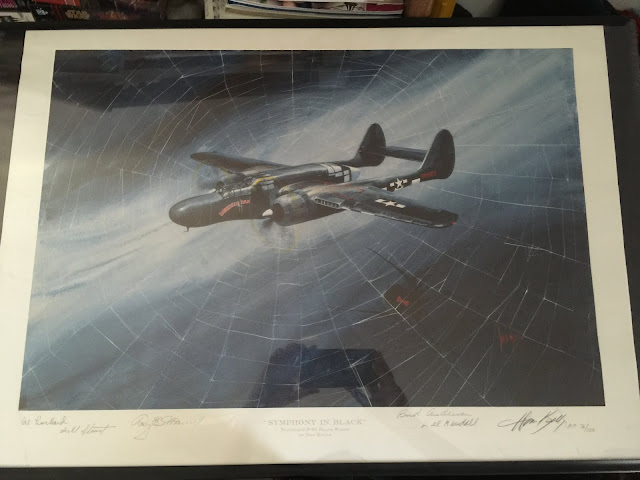
My personal copy of Symphony In Black, SN #79/100. Signed by the artist, Dan Kelly, and Bill Stewart, Al Lockard, Ray Mann, Alvin E. "Bud" Anderson, and Lee Kendall

Three of the four aircraft in Gary Olson's Night Fighters series. From Left to Right is the DeHavilland Mosquito, Bristol Beaufighter, and Northrup P-61B. Not shown is the Douglas P-70.

I was hooked. I knew very little about night fighters, a side of the WWII air war that is rarely written about, but was no less important. More than that, staring at these pictures made me want to see one of these aircraft in person – the P-61 Black Widow, the same aircraft that Bill Stewart flew.

Now in the 1990s, if you wanted to see an intact P-61, there were exactly two places in the world you could go: the National Museum of the United States Air Force at Wright-Patterson Air Force Base in Dayton, Ohio, USA; or the Beijing Air and Space Museum in Beijing, China. For me, both those destinations were equally unobtainable. Oh, the National Air and Space Museum had a Black Widow as well, but it was tucked away in one of their storage facilities, another artifact they had no room to display.

Those pictures travelled with me. I grew up, got married, and Symphony in Black went up in our first apartment. We bought our first condo, and Symphony in Black went up office (and eventual nursery) while the India Ink drawings split their locations between the living room and office.

Time passed, and with the opening of the Udvar-Hazy Center at Dulles, the ranks of intact, viewable P-61s grew to three. Still, as a resident of the West Coast, Washington D.C. wasn’t any more convenient than Dayton or Beijing. And that’s how it remained, until an interview brought me out to Washington D.C. in July of last year, with enough time in my schedule after arrival to spend a few hours at the Udvar-Hazy Center.

Seeing the aircraft I’d dreamed about for so many years in person was, to be honest, a bit overwhelming. Sitting in the museum, surrounded by other aircraft of the era, gave a real scale of just how big the P-61 was compared to its contemporaries.

NASM's P-61C-1NO on display. In the post-war era, this aircraft had its weapons removed and was used for swept wing research by NACA. When it was restored and put on display, the decision was made to show it in research, rather than wartime, configuration. Thus the weapons were not replaced for display.

Longer shot to show the scale of the P-61. It dwarfs the single-engine fighters of the same era displayed near it, and really is only outshone by the B-29 Enola Gaybehind it.
I saw a lot of amazing, one of a kind aircraft that day. But when closing time came, the P-61 was the one I came back to for one last look.


I’d also like to note that the Mid-Atlantic Air Museum has a fourth P-61, which they’ve been slowly restoring to flight status since 1991. Assuming they eventually get it completed, I fully intend to be there, to see and hear one of these amazing aircraft fly again!